Here’s a detailed differentiation between CPU, GPU, TPU, and NPU, focusing on their design, purpose, and use cases in computing:

1. CPU (Central Processing Unit)
Overview:
The CPU is the brain of a computer. It is designed for general-purpose tasks and handles all operations in a system, including calculations, logic, control, and input/output (I/O) processing.
Key Features:
- Few cores (2–64 cores typically) optimized for sequential processing.
- High clock speed (e.g., 3–5 GHz).
- General-purpose design suitable for a wide range of tasks.
Strengths:
- Best for single-threaded, sequential tasks (e.g., web browsing, running an operating system, or light data processing).
- Flexible and supports a broad range of programming models.
- High versatility for software applications.
Weaknesses:
- Not optimized for highly parallel tasks (e.g., deep learning or large-scale simulations).
- Power-inefficient for large-scale computations compared to GPUs or specialized processors.
Use Cases:
- Word processing, spreadsheets, and system management.
- Running operating systems.
- Initial prototyping of AI models (small-scale tasks).
2. GPU (Graphics Processing Unit)
Overview:
The GPU is a specialized processor originally designed for rendering graphics and images. It excels at performing thousands of parallel operations simultaneously, making it a favorite for deep learning and computationally intensive workloads.
Key Features:
- Thousands of smaller cores optimized for parallelism.
- Lower clock speed than CPUs but handles massive parallelism.
- Designed for vectorized operations like matrix multiplication.
Strengths:
- Handles tasks requiring high parallelism (e.g., image processing, neural network training).
- Significantly faster for deep learning workloads compared to CPUs.
- Compatible with CUDA and libraries like TensorFlow and PyTorch.
Weaknesses:
- Limited in handling sequential operations efficiently.
- Consumes more power than CPUs for smaller workloads.
Use Cases:
- Deep learning model training (e.g., CNNs and RNNs).
- Gaming and 3D rendering.
- Cryptocurrency mining and scientific computing.
3. TPU (Tensor Processing Unit)
Overview:
TPU is an application-specific integrated circuit (ASIC) developed by Google specifically for accelerating AI workloads, particularly neural networks. It is highly optimized for tensor computations.
Key Features:
- Designed for deep learning tasks.
- Optimized for matrix multiplications and tensor operations.
- Significantly faster than GPUs for specific AI workloads, such as inference and training.
Strengths:
- Efficient and fast for Google’s TensorFlow framework.
- Performs better than GPUs in specific tasks (e.g., BERT model training).
- Highly power-efficient for AI operations.
Weaknesses:
- Limited flexibility (works best with TensorFlow or JAX).
- Not suitable for general-purpose tasks or other frameworks.
Use Cases:
- Google AI projects (e.g., Google Translate, Google Photos).
- Training large-scale deep learning models in the cloud.
- AI inference in edge devices like phones.
4. NPU (Neural Processing Unit)
Overview:
An NPU is a specialized processor designed to accelerate AI workloads, particularly on-device (e.g., smartphones, IoT). It focuses on energy efficiency and real-time AI processing.
Key Features:
- Dedicated hardware for neural network inference.
- Optimized for low-power AI applications.
- Often integrated into mobile chipsets.
Strengths:
- Energy-efficient and suitable for real-time AI tasks.
- Reduces latency by processing AI workloads locally on the device.
- Supports edge applications like voice assistants, facial recognition, and augmented reality.
Weaknesses:
- Not ideal for training large-scale AI models.
- Lower computational power than GPUs and TPUs.
Use Cases:
- Smartphones (e.g., Apple’s Neural Engine, Qualcomm’s Hexagon DSP).
- Real-time image recognition, voice recognition, and AR/VR applications.
- IoT devices and autonomous systems.
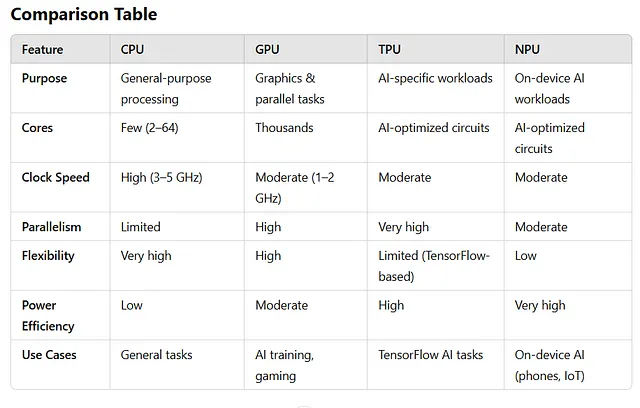
Conclusion
- CPU: Versatile but slower for parallel tasks.
- GPU: Excels in parallelism and widely used in AI and gaming.
- TPU: Optimized for TensorFlow and large-scale AI tasks, especially in Google’s ecosystem.
- NPU: Energy-efficient and designed for on-device AI, enabling real-time inference and low latency.
Each of these processors has a niche, and the choice depends on the application, budget, and computational requirements.
Data Science Enthusiast || AI-ML Engineer Linked in: https://www.linkedin.com/in/abhishek-jain-pict-aiml-enthusiast/